
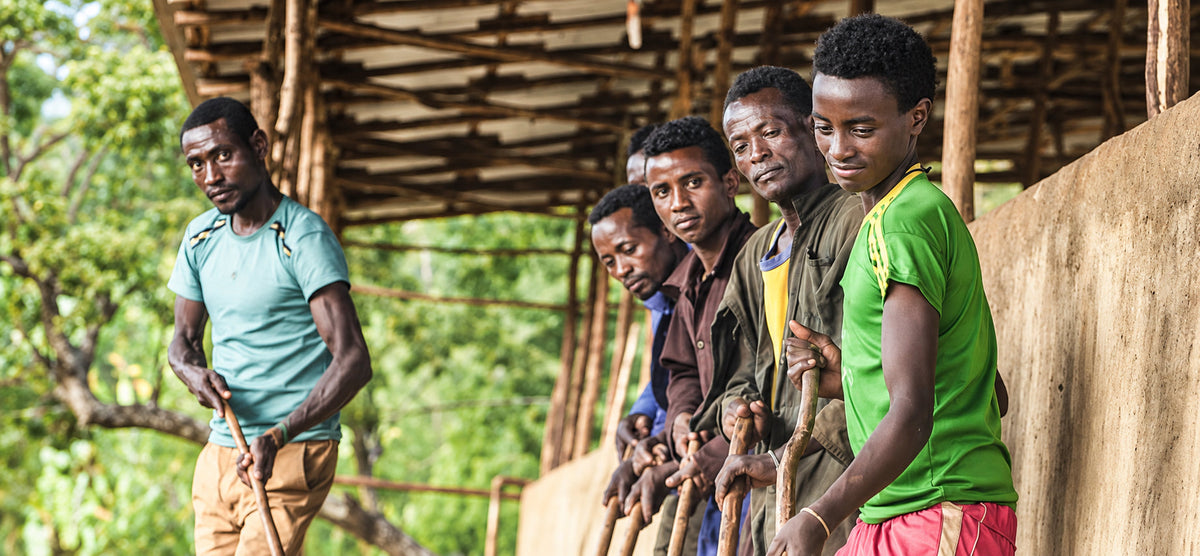
This coffee comes to us through Joel Edwards and the team at Red Fox Coffee Merchants, who connected us this season with a small offering out of Ethiopia's Gedeb woreda, sourced through the export house Moplaco.
The coffee itself traces back to producer Neguesse Debela, who began investing in the Gedeb region a few years ago, drawn to an area that has quietly built a reputation for spectacular coffee over the past decade despite having some of the youngest coffee trees in the country. In 2017, Neguesse opened his first washing station in the kebele of Worka Chelbessa. By 2019, he had expanded to a second site a few kilometers away in a sub-area called Danche. Together, the two stations, run by Neguesse and his team, produce immaculate washed and natural lots, alongside experimental processing aimed at continually pushing quality further.
From there, the coffee moves through Moplaco, a name with a genuinely remarkable history behind it. The company was founded in 1971 by Yiannis Georgalis, who was born in Hirna, Harrar in 1940 to parents who had fled Europe during the Nazi occupation, eventually settling in Ethiopia, a country that shared their Orthodox Christian roots. Yiannis grew up immersed in the coffee trade and went on to build Moplaco into a name synonymous with meticulous sun-dried Harrar coffee, the standard by which Grade 1 Naturals are still measured today. When he passed away in 2008, his daughter Heleanna Georgalis returned to Ethiopia to take over the family's legacy. In the years since, she has expanded Moplaco's reach well beyond Harrar, building relationships and washing station infrastructure across Sidamo, Guji, and the Gedeo zone, including Gedeb. It's through that expanded network that a lot like this one, grown and processed by an independent producer, finds its way to export under a name three generations in the making.
At Neguesse's washing station, cherry is sorted in water to remove floaters, depulped, and left to dry-ferment for 48 to 72 hours in marble tanks before washing. From there it moves to raised African beds, where it dries for 15 to 21 days, turned regularly to ensure even moisture loss. The result is classified as Ethiopian Landrace, a nod to the country's remarkable coffee biodiversity and the near impossibility of isolating a single named variety from a region shaped by generations of intermingled cultivation.
The cup reflects all of that care. Asian pear opens things up with a crisp, delicate sweetness. Honey deepens the body through the middle, adding warmth and roundness. Moscato carries the finish, floral and faintly effervescent, the kind of note that lingers pleasantly long after the cup is gone.
We're grateful to Joel and the team at Red Fox for the access to this one, to Neguesse for the work happening on the ground in Gedeb, and to a family whose journey from wartime Europe to the heart of Ethiopian coffee is still being written.
Profile
- Roast: Light
- Region: Gedeb, Gedeo Zone, Ethiopia
- Farm: Worka Chelbessa
- Process: Washed
- Elevation: 1,750–2,000 MASL
- Variety: Ethiopian Landrace
- Cup: Asian Pear, Honey, Moscato
Share:
Mexico –– Nuevo Paraiso
Ethiopia –– Guji Kercha